
Back To Basics: Enzymes Are The Foundation Of Our Lives. Without Enzymes We Will Be Dead.
Last updated on
Enzymes are so vital to our health. Our digestive enzymes, when kept at an optimum level with a consistent juicing diet, will keep many diseases at bay.
What Is An Enzyme And Why Is It So Important?
Enzymes are the catalysts to thousands of chemical reaction in your body. Their main functions are to facilitate optimal nutrient delivery and the efficient excretion of wastes at the cellular level.
When you have ample supply of enzymes in your body, your body will run at an optimal level and it is also efficient in ensuring effective detoxification, ridding your body of waste products to keep your body in excellent health.
There is a reason why Nature has given us an abundance of plant-based foods that are rich in protein, carbohydrates, fat, minerals, vitamins and enzymes. Enzymes are the workhorses that take apart all the necessary nutrients from the food you eat, putting them together, and converting them into substances that your body can use.
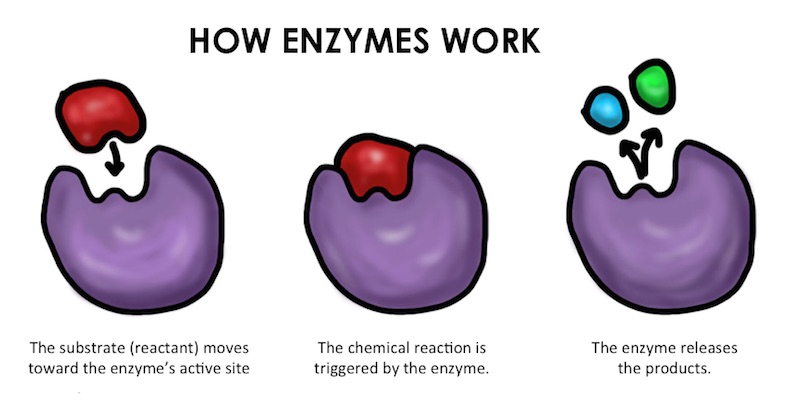
Enzymes are required for the function of ALL of your organs. They rebuild and regenerate tissues, break down and digest your food, purify your blood, and enhance your body’s natural detox efforts.
Enzymes assist in keeping our body in top form, help lower your cholesterol level, clean your colon, break down fats, strengthen your immune system, improve your mental capacity, eliminate carbon dioxide from our lungs, build muscles, and hundreds of other functions.
They supply energy to your body, are involved in your body’s ability for movement, sight, hearing, smelling, tasting, breathing and any actions you do on a day-to-day basis. Without enzymes, death occurs. That is how important enzymes are, they are the very foundation of life!
So, imagine how we abuse our bodies when we feed our bodies with enzyme-deficient food, day after day. It’s no wonder that our body systems start to slow down and deteriorate. And diseases start to set in …
The Enzymes in Our Digestive System
Let us understand how our digestive system works. I will try to explain this in as layman a language as possible.
Our human body produces about 22 known digestive enzymes. These enzymes are essential for healthy digestion, yet it is a nutritional compound that is most neglected. Unfortunately, most people lack these enzymes in their bodies due to the poor choices of food we make, and the way food is prepared that deplete the enzymes.
Enzymes can be replenished by eating the right foods. They are found in abundance in fresh plant foods: grains, fruits and vegetables. When God created fruits and vegetables, He had packaged the necessary enzymes to digest the particular nutrients in that fruit. For example, in a juicy sweet fruit, there is sucrase, the enzyme required to digest sucrose. In fibrous foods there is, packaged together, cellulase to digest them. In grains there is maltase, to digest malt, and so on.

When we cook or process these whole foods, the enzymes are destroyed, causing the foods we consume to be enzyme-deficient and cannot be properly digested. When we consume enzyme-deficient foods, our deprived bodies will have to generate its own enzymes required to digest the food.
The more we depend on our internally-produced enzymes, the more stress we put on our body system and organs. When our body enzymes are busy digesting our heavy (meaty) meal that has no enzyme, their other functions of rebuilding and replenishing our worn-out and damaged cells are neglected.
Enzymes Destroyed
For example, when we eat cooked meat (which of course has to be cooked), the enzymes would be destroyed, making the meat to be of little nutrient value. And meat, by the way, takes up to an average of about 8-12 hours to be digested (and even more for some people).
When you consume meat, your digestive system works extra hard to digest the meat. When the system lacks the required enzymes to do its work, it engages enzymes from other parts of the body to help out, depleting the body’s natural enzymes. That’s why, after a heavy meaty meal, you may feel lazy and sleepy. This is because more enzymes than necessary are consumed and are working overtime to digest the meat.
Don’t get too smart and eat plenty of fruits after you consume a huge meal, expecting the fruits to do its job in providing enzymes for digestion. It doesn’t work that way.
Fruits take up to an hour to digest. And, because meat takes much longer to digest, the fruit you consume after a meal will just sit on top of the undigested food in your digestive tract. This causes the fruit sugar to ferment in your stomach and it starts to putrefy, produce gas, and cause a host of problems to your health.
Exception: When you do eat a huge meal, drink with it a glass of fresh pineapple juice afterwards (not canned). Pineapple is rich in bromelain which aids digestion by breaking down protein.
Types Of Enzymes
Enzymes are basically classified into three main groups—metabolic enzymes, food enzymes, and digestive enzymes.
Metabolic enzymes exist throughout our entire body system—in our organs, bones, blood and cells. Their job is to grow new cells and maintain every tissue in our body. When these enzymes are healthy, robust and present in adequate numbers, they will do their job well.
Digestive enzymes are secreted by our various body organs – by our salivary glands, stomach, pancreas and small intestine. As its name suggests, the function of the digestive enzymes is to help in the digestion of our food.
Inadequate digestive enzymes results in
left-over wastes which toxify our body system.
The following are a few commonly known enzymes:
- lipase — for breaking down of fats
- protease — for breaking down of proteins
- cellulase — for breaking down of fiber
- amylase — for breaking down of starch
- lactase — for breaking down of dairy products
- sucrase — for breaking down of sugar
- maltase — for breaking down of sugar in grains
- invertase — for breaking down of sucrose found in cane or beet sugars
- alpha-galactosidase — for breaking down of starches in beans and cruciferous vegetables. Incomplete breakdown of these starches can cause gas.
These enzymes are typically named using ~ase with the name of the chemical being transformed, e.g. lipase for lipids (fats), or lactase for lactose, etc.
Inadequate numbers of any of these digestive enzymes results in incomplete digestion of food in their respective category. This causes left-over wastes which toxify the body system.
Food enzymes exist naturally in the raw food that we consume. Its functions are very much like the digestive enzymes, that is to assist in the digestion of our food. When we consume foods that are rich in enzymes, the foods will be “self-digested”, causing less or no stress to our body.
Here’s Something Exciting: What Food Enzymes Do To Our Blood
These are images of a person’s blood being analyzed under the microscope. A sample blood is taken of a person whose body is lacking in nutrients and enzymes. The blood cells are clustered together and moving very slowly. (This may eventually lead to stroke.)

This person was then given to drink a glass of carrot, green apple and wheatgrass juice, extracted using the Green Power. Half an hour later, a sample blood was taken again to be observed under the microscope. Lo and behold, the blood cells separated and was suddenly moving about very actively.

The blood cells become active when it received sufficient enzymes. One of the functions of our red blood cells is to carry oxygen and nutrients to all parts of the body. When there is sufficient enzymes present in the blood, the blood cells can do their job properly. You see now, how drinking fresh juices regularly can prevent blood clots which can lead to many health problems including thrombosis and heart attacks.
When the blood is toxic and being stagnant or slow moving (caused by eating too much meat and other harmful foods, and not enough enzymes from fresh fruits and juices), it thickens and causes a sluggish system and create untold ailments: from mild ailments like headache/migraine, fatigue, inflammation (e.g. arthritis, gout) to more serious problems like heart diseases and even cancer.
What Happens When You Are Enzyme Deficient
After a prolonged period of being enzyme deficient, and not replenishing them quick enough, two things happen:
- Your body works overtime to produce more enzymes, causing extra stress which affects your immune system. This lowers your ability to protect from and fight diseases.
- Your digestive system eventually slows down for lack of enzymes, causing food to be undigested. This undigested food stays in your system and begins to ferment and pollute your blood (a condition called “toxemia“).
Significant short and long-term health problems start to take place. Diabetes, high blood pressure, kidney disease, migraine, PMS, bowel disorder, food allergies, acne, psoriasis, bloating, flatulence, fatigue, anxiety, depression and a long list of other diseases are results of toxemia.
On the other hand, when your enzymes intake is constantly kept at an optimum level, you can expect very minimal wear and tear to your body.
How To Maintain An Optimum Enzymes Level
Once you understand the enzyme-robbers, there are some things you can do.
- Change your eating habits and lifestyle so that you can reduce the stress on your digestive system. We will discuss the possible ways of doing this, on other pages on this site, about where we could have gone wrong and how we can rectify the situation.
- Constantly replenish your body with enzymes. There are two ways you can do this. One, is by taking enzymes supplement. I prefer the natural approach by taking fresh fruits and vegetables that are very rich in enzymes. And because we have many years to catch up for having eaten poorly, we can replenish our bodies quickest by drinking fresh fruit and vegetable juices. This is what this website is about.
- Eating probiotics regularly is as important as eating foods rich in enzymes as it helps improve and enhance nutrient absorption in the gut. While you can take probiotics in the form of supplements, some excellent sources of probiotics are from traditionally fermented foods. One of my favorite ways is to take 2-4 tablespoons of apple cider vinegar every day—it provides me with a full range of nutrients, enzymes and probiotics—everything necessary to strengthen my immune system, and keep my health in tip-top condition.
- And finally, understand that we always have a choice concerning what we put into our mouth. Read up on the free information on this site to find out about the how’s and what’s and when’s, etc. Choose today to want to live healthy.
Once you know what foods are harmful, you would look at the food and not desire it. And once you know what foods are healing, strive to eat more of it.
All the best in your journey … it will be worth it.
Some of the links I post on this site are affiliate links. If you go through them to make a purchase, I will earn a small commission (at no additional cost to you). However, note that I’m recommending these products because of their quality and that I have good experience using them, not because of the commission to be made.

Comments
Leave a Reply


 JOIN OVER
Can you list me the food items as to be consumed daily which are rich in enzymes
All raw food contains the enzymes necessary to digest that food. Enzymes are depleted through time so it is necessary to involve raw foods into your diet.
I am taking Digest Spectrum 3x daily 1/2 hour before my meals and was told no drinking liquid during the meal and 1-2 hours after ( which I found impossible to follow) but my question is how do I manage juicing as a meal in itself?
Thank you for your interesting article and your response.My best,
Elaine
Juicing should not replace a full meal unless you are trying a juice cleanse.
If your “pills” are that strict do not use them with fresh cold-pressed juice which contain already living enzymes. If you are getting fresh juice without time lapsing, or if it is cold-pressed, they will contain all the enzymes you need for the juice itself. As for the rest of your meal ask yourself, are you noticing a difference with these pills? The difference should be a lighter feeling, more energy than without them, and less digestive irritability.
Thanks a lot … It’s great and valuable information, highly appreciated the way it’s explained.
I have to say, I was really diggin this entry. You almost had me. I was literally on the edge of my seat, or well, my bed, tbh, until the whole toxemia bit. Toxemia is preeclampsia, and it’s a complication of pregnancy. What does it have to do with any of this? An explanation would be great, thanks.